Sunday, April 24, 2011

Happy Fertility And Rebirth

Annabessacook Farm Eggs

Spring is here, there's no mistaking, farmers tilling soil from coast to coast. Today, Christians celebrate Easter. Farmers celebrate new beginnings. Miracle lambs and baby goats. Seedlings poking through wet soil. Pullets dropping eggs like rain.

Enjoy your celebrations.

Saturday, April 16, 2011

Spring Babies At Annabessacook Farm


A slideshow of baby goats Stew and Boter, and our surprise lamb Mushroom, born in the rain and mud. Best viewed in full screen mode.

Thursday, March 31, 2011

Silver Striking Crystal: The Harvard Callbacks Sterling Anniversary Jam

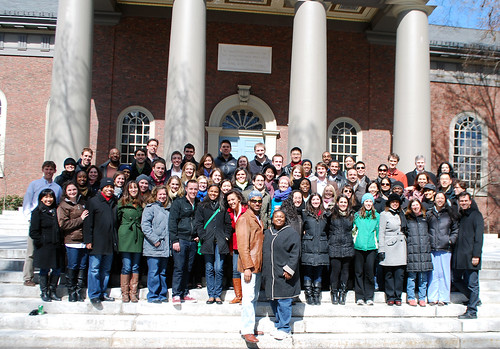
callbacks group picture

On September 1, 1986, according to official records, I founded the Harvard Callbacks along with Morgan London, then called Dawn Clark, two legal name changes earlier. Both voluntary, one by marriage. I, too, have had a legal name change. Involuntary. By adoption. That the two of us would join to found what can be described as a family and an a capella singing group is beyond serendipity.

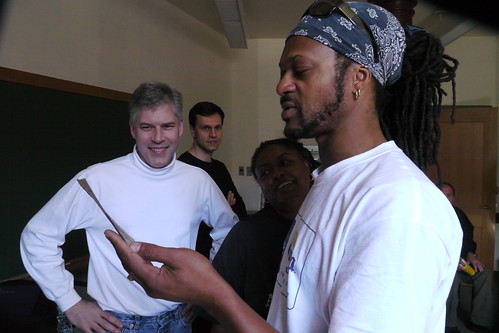
P1110226
I'm looking at some piece of memorabilia here. Probably the photo of us singing for the elderly at Neville Manor as seen below.

You see, the Callbacks saved my life. Saved Dawn called Morgan's life, too. I was probably the most depressed I've ever been in life during my college years. I get the feeling Dawn called Morgan was, too. And so our starting and participating in a group that defined our college years, that became a family we created for ourselves, literally saved our lives. And sustained them. Morgan Inniss, in changing her name from Dawn Clark, divorced herself from her biological family. Days after my birth, my biological family had divorced itself from me, then called Joseph White, till I found a home with a family as Craig Hickman.

P1110276
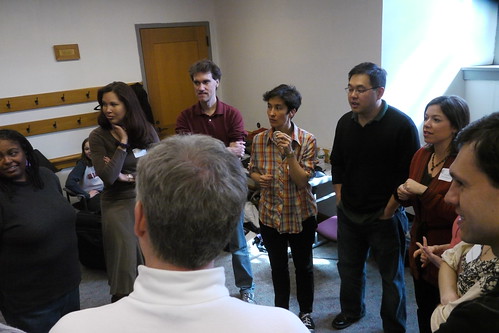
The Paleo-Callbacks getting ready for our alumni set.

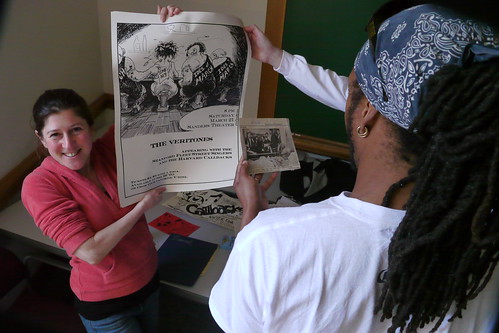
P1110221
Debbie Steinbaum brought all the archival gems to pass along to the new generation. Here she holds a poster of the Veritones jam where we were invited as an opening act.

And so it was also beyond serendipity that Morgan and I would both fly to the Harvard Callbacks 25th Anniversary Jam from Florida; she from her home outside Jacksonville, me from a tennis event I was covering in Miami, where just the day before, I saw my birth father again for the first time since my 34th birthday in 2001. That her husband, whom I met for the first time at the jam but who seemed as familiar to me as the sun, would break down and cry during a performance of Sarah McLachlan's "Angel" remembering his father who'd died on Christmas day. That I had just visited my ailing mother in Milwaukee to observe the 4th anniversary of my father's death on March 14 before flying to Miami. And so it was no wonder at all that Dawn called Morgan and I would connect so profoundly back then, starting a family we never planned.

We just wanted to sing.

IMG_0598
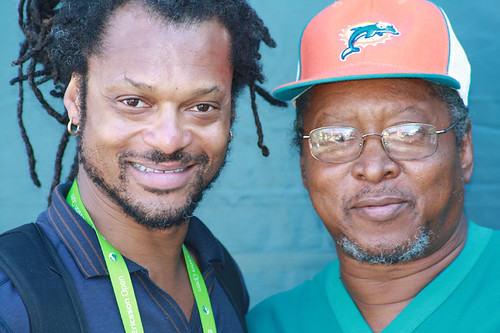
In Florida with my birth father, Frank. Photo by other half.

P1110246
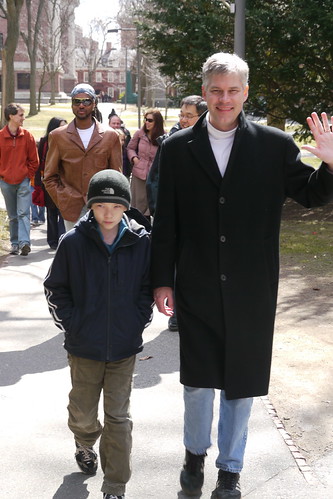
Our first president, Don Ridings, and his son Erik. This was the first reunion concert Don attended and I, for one, was ecstatic to see him.

When the dean of students wanted us to disappear, we persevered instead. We staged concerts in Paine Hall, Dunster House, and Leverett Dining Hall, among other places. No founding Callback ever hosted a jam in Sanders Theater. There were moments, at previous reunions, when I wish I knew the tenor parts of the songs the current group was singing. I would have jumped onto the stage and performed in the whole set just to say I finally got to do a whole show in Sanders. Instead, I remembered Paine Hall and hand-designed posters and tie-died banners. We had no budget. We had no vision.

We just wanted to sing.

P1110364
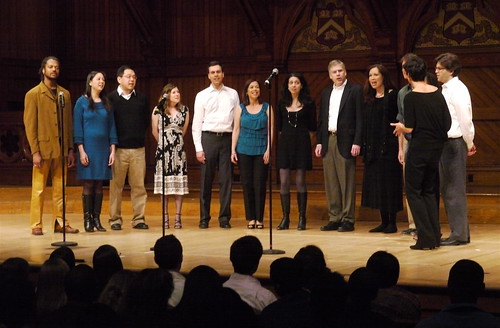
We looked good and sounded even better.

P1110395
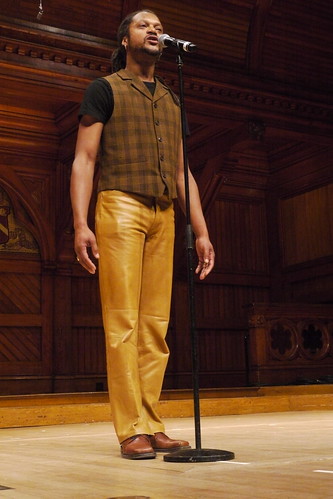
Doing the poetry slam thing. Read the poem right here.

25 years later, what we created has grown and changed and changed and grown.

The current group of Callbacks, many of whom weren't even thought about when Dawn called Morgan and I stood before Holden Chapel in Harvard Yard and declared that we would start a group (we wanted to sing, damnit, and nothing whatsoever was going to stop us), signed a card for each of us and presented them to us after the Sterling Anniversary Jam this past Saturday night.

"Thanks for helping define my Harvard experience," wrote one Callback.

"I'm so happy you founded the Callbacks -- it has become one of the most important experiences of my life. I'm so glad I got to meet you," wrote another.

And then there are these:

"Thank you so much for creating this family of singers. The CBs have been so essential and important in my life. Thank you!"

"The Callbacks have been a wonderful experience and a great addition to the Harvard community. Thank you so much for everything."

"Thank you for all your efforts in starting the CB's. The group has become my family."

"The Callbacks have filled the last 4 years with amazing music and wonderful memories. Thank you for starting the group that has become my family."

The more things change, the more they remain the same.

I did well to get through the concert without blubbering. Not so hours later when reading the card just before bed.

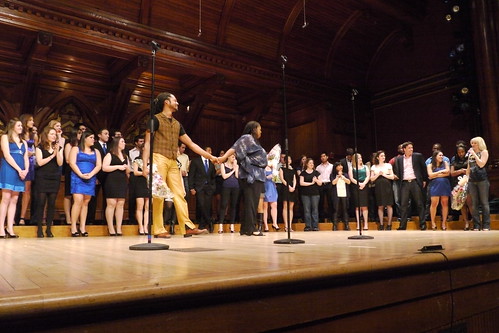
After singing our signature songs "Old Irish Blessing" and "The Letter", Chris Heller, the current president, gave Morgan and me each a beautiful bouquet of flowers. After, when we embraced, in front of family, before fans and friends, Morgan confessed in my ear, "This is the proudest moment of my life."

P1110405

With six generations of Callbacks standing in a giant horseshoe on stage behind us, who had just demonstrated how much college a capella singing has evolved over the last quarter century, who now applauded enthusiastically along with the audience while we embraced, it was hard to think of another moment in life when I was prouder.

There's nothing more important than family.

(All Callbacks photos by Callbacks progeny, Lila Cardillo and Erik Ridings.)

Sunday, March 06, 2011

Sunday With Ethel :: His Eye Is On The Sparrow


Song from the 1952 movie "The Member of the Wedding" With Ethel Waters as Bernice Sadie Brown; Julie Harris as Frankie Addams; and Brandon De Wilde as John Henry.

Sunday, February 27, 2011

Sunday With Sam :: A Change Is Gonna Come


From wikipedia:

Origins

Upon hearing Bob Dylan's "Blowin' in the Wind" in 1963, Cooke was greatly moved that such a poignant song about racism in America could come from someone who was not black[1]. While on tour in May 1963, and after speaking with sit-in demonstrators in Durham, North Carolina following a concert, Cooke returned to his tour bus and wrote the first draft of what would become "A Change Is Gonna Come". The song also reflected much of Cooke's own inner turmoil. Known for his polished image and light-hearted songs such as "You Send Me" and "Twistin' the Night Away", he had long felt the need to address the situation of discrimination and racism in America, especially the southern states. However, his image and fears of losing his largely white fan base prevented him from doing so.

The song, very much a departure for Cooke, reflected two major incidents in his life. The first was the death of Cooke's 18-month-old son, Vincent, who died of an accidental drowning in June of that year. The second major incident came on October 8, 1963, when Cooke and his band tried to register at a "whites only" motel in Shreveport, Louisiana and were summarily arrested for disturbing the peace. Both incidents are represented in the weary tone and lyrics of the piece, especially the final verse: There have been times that I thought I couldn't last for long/but now I think I'm able to carry on/It's been a long time coming, but I know a change is gonna come.

Recording

After remaining confined to Cooke's notebooks for months of touring, "A Change Is Gonna Come" was finally recorded on December 21, 1963. Recording took place at the RCA Studios in Los Angeles, California during sessions for Cooke's 1964 album, Ain't That Good News.

According to author Peter Guralnick's biography of Cooke, "Dream Boogie", Cooke gave arranger Rene Hall free rein on the song's musical arrangement. Hall came up with a dramatic orchestral backing highlighted by a mournful French horn. For his vocal, Cooke reached back to his gospel roots to sing the song with an intensity and passion never heard before on his pop recordings.

Release

The song made its first appearance on Ain't That Good News, the last album to be released within Cooke's lifetime. The LP did well, peaking at number 34 on the Billboard Pop Albums chart, making it more successful than Cooke's previous LP, 1963's Night Beat.

However, Cooke and his new manager Allen Klein thought the song deserved greater exposure. According to Guralnick's book, Klein persuaded Cooke to sing "A Change Is Gonna Come" on his February 7, 1964 appearance on The Tonight Show. Cooke sang the song; unfortunately, any impact it made was dimmed by The Beatles' history-making appearance on The Ed Sullivan Show just two days later. In a further misfortune, NBC did not save the tape of Cooke's performance, which has never turned up in private collections either. RCA Records had bypassed "Change" for Cooke's early 1964 single, instead releasing the tracks "Good Times" and "(Ain't That) Good News". But the company agreed to put the song out as a single late in the year, as the B-side to Cooke's latest potential hit, "Shake." At one of his last recording sessions, Cooke approved an edit to the song that would shorten it by about 30 seconds, increasing its chance for airplay on American radio stations.

Finally given proper attention, "A Change Is Gonna Come" became a sensation among the black community, and was used as an anthem for the ongoing civil rights protests. On R&B radio, the song peaked at number 9 on the Billboard Black Singles chart, and topped many local playlists, most notably in Chicago. The song had more limited success on top 40 radio. By February 1965, the song had peaked at number 31 on the Billboard Pop Singles chart and fallen off. Cooke, however, did not live to see the song's commercial success. On December 11, 1964, he was killed at the Hacienda Motel in Los Angeles, California under what some consider mysterious circumstances.

Legacy

Though only a moderate success sales-wise, "A Change Is Gonna Come" became an anthem for the American Civil Rights Movement, and is widely considered Cooke's best composition. Over the years, the song has garnered significant praise and, in 2005, was voted number 12 by representatives of the music industry and press in Rolling Stone magazine's 500 Greatest Songs of All Time, and voted number 3 in the webzine Pitchfork Media's The 200 Greatest Songs of the 60s. The song is also among three hundred songs deemed the most important ever recorded by National Public Radio (NPR) and was recently selected by the Library of Congress as one of twenty-five selected recordings to the National Recording Registry as of March 2007. The song is currently ranked as the 95th greatest song of all time, as well as the seventh best song of 1965, by Acclaimed Music.[2]

Despite its acclaim, legal troubles have haunted the single since its release. A dispute between Cooke's music publisher, ABKCO, and record company, RCA Records, made the recording unavailable for much of the four decades since its release. Though the song was featured prominently in the 1992 film Malcolm X, it could not be included in the film's soundtrack. By 2003, however, the disputes had been settled in time for the song to be included on the remastered version of Ain't That Good News, as well as the Cooke anthology Portrait of a Legend.

"A Change Is Gonna Come" was a precursor to many later socially-conscious singles, including Marvin Gaye's lauded "What's Going On". Al Green, a self-professed fan of Cooke, covered the song for the concert celebrating the 1996 opening of the Rock and Roll Hall of Fame in Cleveland, Ohio. Green's live rendition was included in the soundtrack to the 2001 Michael Mann film Ali. James Taylor recorded a version specially for an episode of the same title of the television drama The West Wing. The Allman Brothers Band captured their performance of the song on their 2003 DVD Live at the Beacon Theatre.

Other notable artists who have covered the song include Allison Moorer, Jeffrey Gaines, Matt Doyle, Cory Wells, Bob Dylan, Aretha Franklin, The 5th Dimension (in a 1970 medley with The Rascals' "People Got to Be Free"), The Band, Wayne Brady, Billy Bragg, Evelyn Champagne King, Solomon Burke, Terence Trent D'Arby, Gavin DeGraw, the Fugees, the Cold War Kids, The Gits, Deitrick Haddon, Patti Labelle, Solo, Prince Buster, Morten Harket, The Neville Brothers, jacksoul, Ben Sollee, Johnny P, Billy Preston, Otis Redding, Baby Huey (singer), Michael Thompson featuring Bobby Womack, Leela James, Tina Turner, The Righteous Brothers (Bobby Hatfield solo), The Gits, Brandy, and The Supremes, The Manhattans, Gerald Alston, Arcade Fire has used the song in support of Barack Obama's nomination for President of the United States. In recent years, the song has served as a sample for rappers Ghostface Killah (1996), Ja Rule (2003), Papoose (2006), Lil Wayne (2007) "Long Time Coming (remix)" Charles Hamilton, Asher Roth, and B.o.B (2009), and Nas's It Was Written album also features a similar opening as the song. On their album The Reunion hip-hop artists Capone-N-Noreaga used an excerpt from the song on the opening track which shares the same title as the Cooke original. British soul singer Beverley Knight says the song is her all time favourite and has performed it live many a time; most notably on 'Later with Jools Holland'. On May 6, 2008, during the seventh season of American Idol, the song was sung by contestant Syesha Mercado as the remaining top 4. After winning the 2008 United States presidential election, Barack Obama referred to the song, stating to his supporters in Chicago, "It's been a long time coming, but tonight, change has come to America." A duet of the song by Bettye LaVette and Jon Bon Jovi was included in We Are One: The Obama Inaugural Celebration at the Lincoln Memorial. In Washington DC, in the days leading up to the Inauguration of Barack Obama, this song could be heard played constantly in the city centre.

Sunday, February 20, 2011

Sunday With Nina :: Mississippi Goddam


In the 1960s, Nina Simone was part of the civil rights movement and later the black power movement. Her songs are considered by some as anthems of those movements, and their evolution shows the growing hopelessness that American racial problems would be solved.

Nina Simone wrote "Mississippi Goddam" after the bombing of a Baptist church in Alabama killed four children and after Medgar Evers was assassinated in Mississipppi. This song, often sung in civil rights contexts, was not often played on radio. She introduced this song in performances as a show tune for a show that hadn't yet been written.

Other Nina Simone songs adopted by the civil rights movement as anthems included "Backlash Blues," "Old Jim Crow," "Four Women" and "To Be Young, Gifted and Black." The latter was composed in honor of her friend Lorraine Hansberry and became an anthem for the growing black power movement with its line, "Say it clear, say it loud, I am black and I am proud!"

With the growing women's movement, "Four Women" and her cover of Sinatra's "My Way" became feminist anthems as well.

But just a few years later, Nina Simone's friends Lorraine Hansberry and Langston Hughes were dead. Black heroes Martin Luther King, jr., and Malcolm X, were assassinated. In the late 1970s, a dispute with the Internal Revenue Service found Nina Simone accused of tax evasion; she lost her home to the IRS.

Nina Simone's growing bitterness over America's racism, her disputes with the record companies she called "pirates," her troubles with the IRS all led to her decision to leave the United States. She first moved to Barbados, and then, with the encouragement of Miriam Makeba and others, moved to Liberia.

A later move to Switzerland for the sake of her daughter's education was followed by a comeback attempt in London which failed when she put her faith in a sponsor who turned out to be a con man who robbed and beat her and abandoned her. She tried to commit suicide, but when that failed, found her faith in the future renewed. She built her career slowly, moving to Paris in 1978, having small successes.

In 1985, Nina Simone returned to the United States to record and perform, choosing to pursue fame in her native land. She focused on what would be popular, de-emphasizing her political views, and won growing acclaim. Her career soared when a British commercial for Chanel used her 1958 recording of "My Baby Just Cares for Me," which then became a hit in Europe.

Nina Simone moved back to Europe -- first to the Netherlands then to the South of France in 1991. She published her biography, I Put a Spell on You, and continued to record and perform.

There were several run-ins with the law in the 90s in France, as Nina Simone shot a rifle at rowdy neighbors and left the scene of an accident in which two motorcyclists were injured. She paid fines and was put on probation, and was required to seek psychological counseling.

In 1995, she won ownership of 52 of her master recordings in a San Francisco court, and in 94-95 she had what she described as "a very intense love affair" -- "it was like a volcano." In her last years, Nina Simone was sometimes seen in a wheelchair between performances. She died April 21, 2003, in her adopted homeland, France.

In a 1969 interview with Phyl Garland, Nina Simone said:

There's no other purpose, so far as I'm concerned, for us except to reflect the times, the situations around us and the things we're able to say through our art, the things that millions of people can't say. I think that's the function of an artist and, of course, those of us who are lucky leave a legacy so that when we're dead, we also live on. That's people like Billie Holiday and I hope that I will be that lucky, but meanwhile, the function, so far as I'm concerned, is to reflect the times, whatever that might be.


Monday, February 14, 2011

Honoring My Father

TODAY my father would have been 91-years-old. A Tuskegee Airman, for which he was very proud, my father was a strong man who taught me how to care for others, especially when they are needy or sick. I will honor him today by excerpting the Book of Hazelle from Fumbling Toward Divinity.

1
AND IT CAME TO PASS in those days that Hitler committed suicide in his Berlin bunker. One week later, during the second week of May in the nineteen hundred and forty-fifth year, Nazi Germany surrendered unconditionally and the war in Europe ended.

In the first weeks of August, the United States dropped the atomic bomb on Nagasaki and Hiroshima and the Soviet Union declared war on Japan and invaded Manchuria. On the fourteenth day of the month, Japan announced its surrender—so long as it could keep its emperor—and World War II, a most devastating war in terms of material destruction, global scale, and lives lost, ended.

Hazelle returned from the Philippines, where he had been stationed since the nineteen hundred and forty-second year, and found that the country he’d left behind wasn’t too kind to Negro servicemen returning from war.

Hazelle came back through California with a few of the others he’d attended Tuskegee with in the nineteen hundred and thirty-ninth year. After hanging out in the Arizona desert, he returned to Tennessee, to the city of Beale Street and barbeque, basement slow dances and jazz, three years before Elvis moved in from Tupelo, Mississippi.

Still, Hazelle couldn’t find work. And so it was on the fifteenth day of January in the nineteen hundred and forty-sixth year that he went up from Memphis, Tennessee, to Milwaukee, Wisconsin, on a Greyhound bus. “Mighty nice day for a bus ride,” said Hazelle looking up at the driver from the curb. “What’s your name, sir?”

“Frankie,” the driver responded.

“My name is Hazelle, but you can call me Mister Charlie.” His tone was respectful with a hint of sarcasm. Hazelle tipped his hat to Frankie, flashed his gold tooth and moved to the back of the bus. And so he went up on a Greyhound Bus to the beer capital of America where his one-and-only brother Willie Lee said it was easier for a Negro man to find work.

2
Hazelle the second son was born by a midwife to Lee and Emma Ball Hickman in Inverness, Mississippi, sometime in the second month of the year.

Apparently, on the day he was born, no one glanced at the calendar. If someone had, they failed to record what day it was.

It wouldn’t become clear until the nineteen eighties exactly when Hazelle was born (and even then, his wife would ferociously debate the date or attempt to conceal the obvious), but throughout most of his life, Hazelle observed his birth on the twentieth day of February, in the nineteen hundred and twenty-fourth year.

Whenever he was born, one thing was clear without refute—Hazelle was jazz’s fraternal twin. Hazelle may not have been born in New Orleans, but he and jazz grew up together in the nineteen twenties, matured in the thirties, and took to the world in the forties. Hazelle claimed to have met Bessie Smith, heard Louis Armstrong play live, and auditioned for one of Billie Holiday’s back-up singers in Harlem—all before entering the service at the age of sixteen.

Believing himself sixteen-years-old in nineteen hundred and forty, he had to lie to gain entrance into the service, which only admitted young men of eighteen. Hazelle was blessed with a full head of gray hair at the ripe age of twelve (or sixteen, as the case may be). The service had no difficulty believing him to be nineteen.

3
And so it was that Hazelle entered the Army Air Force and concerned himself with the taking off and landing of airplanes. During the Second World War, he became a plotter. When he got to Milwaukee, Hazelle pursued his desire to work at a civilian airport.

Dressed up sharp, Army Air Force papers in hand, Hazelle took the long trolley ride from Sixth and Vine streets, where he lived with his brother, through the south side to General Mitchell Field, Milwaukee’s municipal airport.

He had called ahead for the interview, and over the phone, the hiring manager thought that Hazelle’s military plotting experience made him a very good candidate for the job of air traffic controller.

“Hazelle Hickman to see Mister Black about the plotter job.”

The eyes of the bifocaled receptionist with the fire-engine pompadour and pale, freckled skin scanned his tweed pants, his matching jacket, his rust and brown tie with the gold slanted stripes, his silver hair, and his colored skin and replied, “You can have a seat there and he’ll be right with you.”

Hazelle did what he was told, as he had for at least the last six years. Outside the window, he could see the two-engine prop planes rising and landing. Even though an emergency crash landing he’d endured during the war rendered him unwilling and unable to ever get inside those winged steel vessels again, airplanes would always deserve his wonder with their miraculous ability to defy the maw of gravity and take flight.

More than a dozen planes had come and gone while Hazelle waited patiently for Mister Black to be right with him. Finally, the pale-skinned woman emerged from behind a windowed door on the other side of the waiting area. “I’m so sorry that you’ve waited so long and that no one was able to call you before you came all this way. I’m so sorry, really I am. I wish I was able to help you, but the position was filled just today.” Her face flushed red as her mountain of hair. “You know what? Maybe I can help,” she continued, raising the pitch of her voice as though she’d made a remarkable discovery. “Consider this your lucky day. If you check downstairs in personnel, I know for a fact that there are several openings for second- and third-shift janitors.”

“Thank you, ma’am. You tell Mister Black there that I sure hope God blesses him.” He tipped his hat as he walked out the door. “You have yourself a real nice afternoon, ya hear?”

And so Hazelle became an interior decorator, a waiter, a cook, a chef, a house painter, and even pondered a career as a nightclub singer and a recording artist—oh, how that tenor voice could croon!—before he began his thirty-plus year tenure in office services at the Pabst Blue Ribbon Company. But before he met Pabst, he met the woman with whom he’d spend the rest of his life.

4
“I met her almost as soon as I got to Milwaukee. It was forty-six and I couldna been here for more than a month. I went to a USO dance at the Pfister Hotel. They had these events for veterans every so often. They were social gatherings where all the beautiful young ladies might come and give us handsome gentlemen a bit of their time and attention. It was one of the few events back in the day where black and white folk could mingle. They even had a big band. Live. You better believe couples were cuttin a rug, jitterbuggin all over the dance floor.

“I hadn’t yet picked out any beauties to test my toe and get my heart a-jumpin. Then my buddy, Smitty, stopped in the middle of our conversation and raised his eyebrows. He motioned for me to turn and look at the little bit of heaven standin just behind me with a smile on her face bright as a Mississippi morning. I walked right over to her.

“‘Well, hello sunshine,’ I kinda half sung in my best Nat King Cole impersonation. If a colored girl could blush, her face woulda glowed hot as the Arizona desert.

“I reached for her hand. ‘Before you try kissing it,’ she said, pulling her hand gently away from the path to my lips, ‘why don’t you take me on the dance floor and introduce yourself properly.’

“How can a man with a heartbeat resist that? They say it only happens in fairy tales. At the first sight of her, the very first sight, I knew it was love. So I guess you could say our fairy tale started on the dance floor that very night.”

Sunday, February 13, 2011

Sunday With Billie :: Strange Fruit


From Wikipedia:
"Strange Fruit" was a poem written by Abel Meeropol, a Jewish high-school teacher from the Bronx, about the lynching of two black men. He published under the pen name Lewis Allan.[3][4]

In the poem, Meeropol expressed his horror at lynchings, possibly after having seen Lawrence Beitler's photograph of the 1930 lynching of Thomas Shipp and Abram Smith in Marion, Indiana.

[lynching2.jpg]

He published the poem in 1936 in The New York Teacher, a union magazine. Though Meeropol/Allan had often asked others (notably Earl Robinson) to set his poems to music, he set "Strange Fruit" to music himself. The piece gained a certain success as a protest song in and around New York. Meeropol, his wife, and black vocalist Laura Duncan performed it at Madison Square Garden.[5] (Meeropol and his wife later adopted Robert and Michael, sons of Julius and Ethel Rosenberg, who were convicted of espionage and executed by the United States.)[6]

Barney Josephson, the founder of Cafe Society in Greenwich Village, New York's first integrated nightclub, heard the song and introduced it to Billie Holiday. Holiday first performed the song at Cafe Society in 1939. She said that singing it made her fearful of retaliation, but because its imagery reminded her of her father, she continued to sing it. She made the piece a regular part of her live performances.[7]

Holiday approached her recording label, Columbia, about the song, but the company feared reaction by record retailers in the South, as well as negative reaction from affiliates of its co-owned radio network, CBS.[8] Even John Hammond, Holiday's producer, refused. She turned to friend Milt Gabler, whose Commodore label produced alternative jazz. Holiday sang "Strange Fruit" for him a cappella, and moved him to tears. In 1939, Gabler worked out a special arrangement with Vocalion Records to record and distribute the song.[9] Columbia allowed Holiday a one-session release from her contract in order to record it.

She recorded two major sessions at Commodore, one in 1939 and one in 1944. "Strange Fruit" was highly regarded. In time, it became Holiday's biggest-selling record. Though the song became a staple of her live performances, Holiday's accompanist Bobby Tucker recalled that Holiday would break down every time after she sang it.[citation needed]

In her autobiography, Lady Sings the Blues, Holiday suggested that she, together with Lewis Allan, her accompanist Sonny White, and arranger Danny Mendelsohn, set the poem to music. The writers David Margolick and Hilton Als dismissed that claim in their work, Strange Fruit: The Biography of a Song. They wrote that hers was "an account that may set a record for most misinformation per column inch". When challenged, Holiday—whose autobiography had been ghostwritten by William Dufty—claimed, "I ain't never read that book."[10]

(...)

Barney Josephson recognized the power of the song and insisted that Holiday close all her shows with it. When she was ready to begin it, waiters stopped serving, the lights in club were turned off, and a single pin spotlight illuminated Holiday on stage. During the musical introduction, Holiday would stand with her eyes closed, as if she were evoking a prayer. Numerous other singers have performed the work. In October 1939, Samuel Grafton of The New York Post described "Strange Fruit": "If the anger of the exploited ever mounts high enough in the South, it now has its 'Marseillaise'."

::


When I stumbled upon this website, I was floored.

Searching through America's past for the last 25 years, collector James Allen uncovered an extraordinary visual legacy: photographs and postcards taken as souvenirs at lynchings throughout America. With essays by Hilton Als, Leon Litwack, Congressman John Lewis and James Allen, these photographs have been published as a book "Without Sanctuary" by Twin Palms Publishers . Features will be added to this site over time and it will evolve into an educational tool. Please be aware before entering the site that much of the material is very disturbing. We welcome your comments and input through the forum section.

Experience the images as a flash movie with narrative comments by James Allen, or as a gallery of photos which will grow to over 100 photos in coming weeks. Participate in a forum about the images, and contact us if you know of other similar postcards and photographs.
Recently a close friend of mine who grew up in Maine, who had never heard of lynching, spontaneously burst into tears when I described this horror of our nation's past over lunch. The detail that seemed to get to him most were the postcards sent around inviting people to the well-attended lynching parties.

I recommend viewing the flash movie option above. The commentary elicits chills.


[lynching.jpg]

Wednesday, February 09, 2011

Put Your Foot In It: The Culinary Reach Of The African Diaspora


Okra from my farm in Maine.

THIS BOOK will be in my hands before month's end.

In the final chapter of High on the Hog: A Culinary Journey from Africa to America (Bloomsbury, Jan. 4), Jessica B. Harris looks at the culinary cosmos leavened by the narratives of the African diaspora. The Bryn Mawr alum, a tenured professor at Queens College who holds a Ph.D. from NYU, beckons the reader into a sacred, long-loved cookery where iron pots of gumbo and the aromas of praline and molasses speak to the centuries, continents and cultures traversed by African-Americans.

Harris, the author of 11 cookbooks, uses her latest to follow the foodways of the diaspora, from the West African vendors selling pepperpot on the streets of Philadelphia to the chuckwagon cooks in the Westward migration. Throughout, Harris traces the story of African-American chefs who found cooking as a means of expression and social mobility. Harris will read from High on the Hog at the Free Library Feb. 1.

City Paper: Why write this more historically based book instead of another cookbook?

Jessica B. Harris: I thought it was time to start the dialogue about the history of this food, and the history of its people as seen through the food. We live in a world of cookbooks — Lord knows, I've contributed 11 to that world — but this is just a deeper, perhaps more thoughtful, study of it.

CP: In High on the Hog, you go back to dishes that were popular in the 18th century, many of which we don't see in the same form anymore. Has this influenced how you cook?

JH: Actually, no. I cook the same way as always. There's food that I research and there's food that I eat every night for dinner. In some cases, I will cook traditional African-American dishes for celebrations or traditional dishes from the diaspora.

CP: Have we lost some of this traditional food in our culture?

JH: Not that much has been lost, actually. People eat okra, people eat sesame, people eat watermelon. All of these are ingredients that came from the African continent. Much of what we eat on a daily basis is food and foodstuff that comes from Africa. We just are largely unaware that they do. ... Did you have a cup of coffee this morning?

CP: Yes, several.

JH: In fact and indeed, coffee originated in the Ethiopian Highlands. That's what I mean. Most of us don't know that.

Read the rest....

I didn't know it. Learn something new everyday.