February 14, 1920 - March 14, 2007
Musings about art, life, spirit and love by an adult adoptee living in reunion.
Wednesday, March 14, 2012
Five Years Ago Today
February 14, 1920 - March 14, 2007
Thursday, December 08, 2011
Friday, November 11, 2011
Saluting Our Veterans
Monday, August 22, 2011
Sunday, April 24, 2011
Happy Fertility And Rebirth
Thursday, March 31, 2011
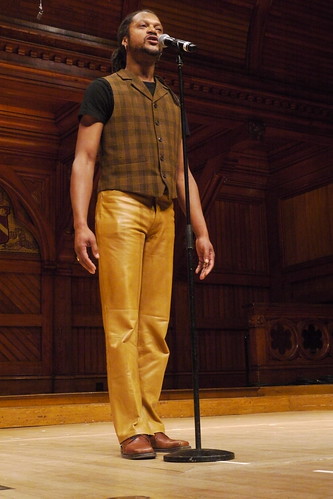
Silver Striking Crystal: The Harvard Callbacks Sterling Anniversary Jam

On September 1, 1986, according to official records, I founded the Harvard Callbacks along with Morgan London, then called Dawn Clark, two legal name changes earlier. Both voluntary, one by marriage. I, too, have had a legal name change. Involuntary. By adoption. That the two of us would join to found what can be described as a family and an a capella singing group is beyond serendipity.

I'm looking at some piece of memorabilia here. Probably the photo of us singing for the elderly at Neville Manor as seen below.
You see, the Callbacks saved my life. Saved Dawn called Morgan's life, too. I was probably the most depressed I've ever been in life during my college years. I get the feeling Dawn called Morgan was, too. And so our starting and participating in a group that defined our college years, that became a family we created for ourselves, literally saved our lives. And sustained them. Morgan Inniss, in changing her name from Dawn Clark, divorced herself from her biological family. Days after my birth, my biological family had divorced itself from me, then called Joseph White, till I found a home with a family as Craig Hickman.

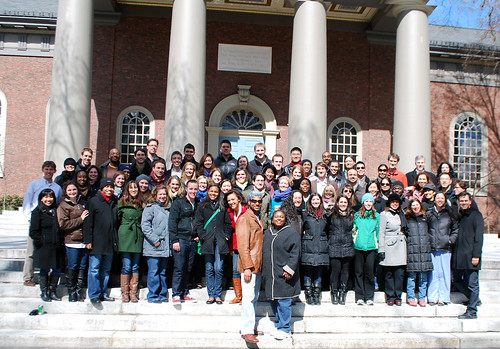
The Paleo-Callbacks getting ready for our alumni set.

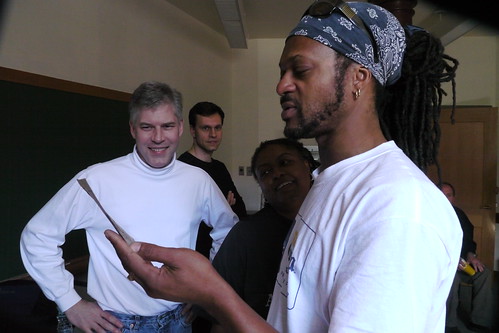
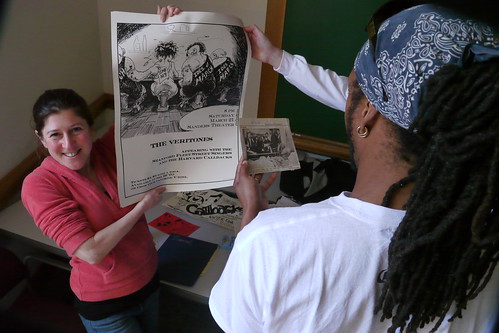
Debbie Steinbaum brought all the archival gems to pass along to the new generation. Here she holds a poster of the Veritones jam where we were invited as an opening act.
And so it was also beyond serendipity that Morgan and I would both fly to the Harvard Callbacks 25th Anniversary Jam from Florida; she from her home outside Jacksonville, me from a tennis event I was covering in Miami, where just the day before, I saw my birth father again for the first time since my 34th birthday in 2001. That her husband, whom I met for the first time at the jam but who seemed as familiar to me as the sun, would break down and cry during a performance of Sarah McLachlan's "Angel" remembering his father who'd died on Christmas day. That I had just visited my ailing mother in Milwaukee to observe the 4th anniversary of my father's death on March 14 before flying to Miami. And so it was no wonder at all that Dawn called Morgan and I would connect so profoundly back then, starting a family we never planned.
We just wanted to sing.

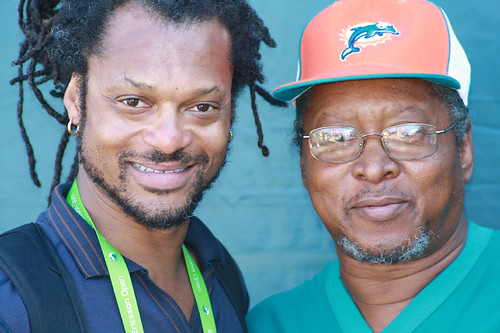
In Florida with my birth father, Frank. Photo by other half.

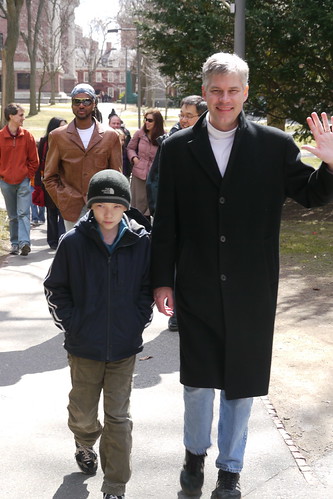
Our first president, Don Ridings, and his son Erik. This was the first reunion concert Don attended and I, for one, was ecstatic to see him.
When the dean of students wanted us to disappear, we persevered instead. We staged concerts in Paine Hall, Dunster House, and Leverett Dining Hall, among other places. No founding Callback ever hosted a jam in Sanders Theater. There were moments, at previous reunions, when I wish I knew the tenor parts of the songs the current group was singing. I would have jumped onto the stage and performed in the whole set just to say I finally got to do a whole show in Sanders. Instead, I remembered Paine Hall and hand-designed posters and tie-died banners. We had no budget. We had no vision.
We just wanted to sing.

We looked good and sounded even better.

Doing the poetry slam thing. Read the poem right here.
25 years later, what we created has grown and changed and changed and grown.
The current group of Callbacks, many of whom weren't even thought about when Dawn called Morgan and I stood before Holden Chapel in Harvard Yard and declared that we would start a group (we wanted to sing, damnit, and nothing whatsoever was going to stop us), signed a card for each of us and presented them to us after the Sterling Anniversary Jam this past Saturday night.
"Thanks for helping define my Harvard experience," wrote one Callback.
"I'm so happy you founded the Callbacks -- it has become one of the most important experiences of my life. I'm so glad I got to meet you," wrote another.
And then there are these:
"Thank you so much for creating this family of singers. The CBs have been so essential and important in my life. Thank you!"
"The Callbacks have been a wonderful experience and a great addition to the Harvard community. Thank you so much for everything."
"Thank you for all your efforts in starting the CB's. The group has become my family."
"The Callbacks have filled the last 4 years with amazing music and wonderful memories. Thank you for starting the group that has become my family."
The more things change, the more they remain the same.
I did well to get through the concert without blubbering. Not so hours later when reading the card just before bed.
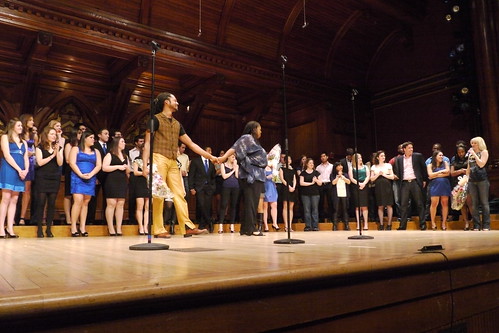
After singing our signature songs "Old Irish Blessing" and "The Letter", Chris Heller, the current president, gave Morgan and me each a beautiful bouquet of flowers. After, when we embraced, in front of family, before fans and friends, Morgan confessed in my ear, "This is the proudest moment of my life."

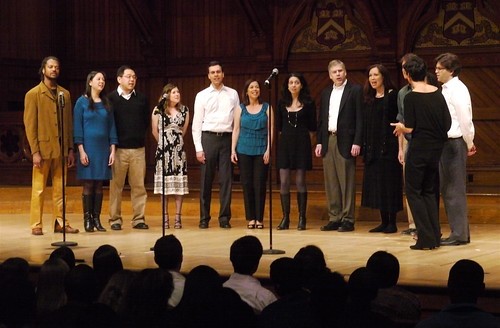
With six generations of Callbacks standing in a giant horseshoe on stage behind us, who had just demonstrated how much college a capella singing has evolved over the last quarter century, who now applauded enthusiastically along with the audience while we embraced, it was hard to think of another moment in life when I was prouder.
There's nothing more important than family.
(All Callbacks photos by Callbacks progeny, Lila Cardillo and Erik Ridings.)
Monday, February 14, 2011
Honoring My Father
1
AND IT CAME TO PASS in those days that Hitler committed suicide in his Berlin bunker. One week later, during the second week of May in the nineteen hundred and forty-fifth year, Nazi Germany surrendered unconditionally and the war in Europe ended.
In the first weeks of August, the United States dropped the atomic bomb on Nagasaki and Hiroshima and the Soviet Union declared war on Japan and invaded Manchuria. On the fourteenth day of the month, Japan announced its surrender—so long as it could keep its emperor—and World War II, a most devastating war in terms of material destruction, global scale, and lives lost, ended.
Hazelle returned from the Philippines, where he had been stationed since the nineteen hundred and forty-second year, and found that the country he’d left behind wasn’t too kind to Negro servicemen returning from war.
Hazelle came back through California with a few of the others he’d attended Tuskegee with in the nineteen hundred and thirty-ninth year. After hanging out in the Arizona desert, he returned to Tennessee, to the city of Beale Street and barbeque, basement slow dances and jazz, three years before Elvis moved in from Tupelo, Mississippi.
Still, Hazelle couldn’t find work. And so it was on the fifteenth day of January in the nineteen hundred and forty-sixth year that he went up from Memphis, Tennessee, to Milwaukee, Wisconsin, on a Greyhound bus. “Mighty nice day for a bus ride,” said Hazelle looking up at the driver from the curb. “What’s your name, sir?”
“Frankie,” the driver responded.
“My name is Hazelle, but you can call me Mister Charlie.” His tone was respectful with a hint of sarcasm. Hazelle tipped his hat to Frankie, flashed his gold tooth and moved to the back of the bus. And so he went up on a Greyhound Bus to the beer capital of America where his one-and-only brother Willie Lee said it was easier for a Negro man to find work.
2
Hazelle the second son was born by a midwife to Lee and Emma Ball Hickman in Inverness, Mississippi, sometime in the second month of the year.
Apparently, on the day he was born, no one glanced at the calendar. If someone had, they failed to record what day it was.
It wouldn’t become clear until the nineteen eighties exactly when Hazelle was born (and even then, his wife would ferociously debate the date or attempt to conceal the obvious), but throughout most of his life, Hazelle observed his birth on the twentieth day of February, in the nineteen hundred and twenty-fourth year.
Whenever he was born, one thing was clear without refute—Hazelle was jazz’s fraternal twin. Hazelle may not have been born in New Orleans, but he and jazz grew up together in the nineteen twenties, matured in the thirties, and took to the world in the forties. Hazelle claimed to have met Bessie Smith, heard Louis Armstrong play live, and auditioned for one of Billie Holiday’s back-up singers in Harlem—all before entering the service at the age of sixteen.
Believing himself sixteen-years-old in nineteen hundred and forty, he had to lie to gain entrance into the service, which only admitted young men of eighteen. Hazelle was blessed with a full head of gray hair at the ripe age of twelve (or sixteen, as the case may be). The service had no difficulty believing him to be nineteen.
3
And so it was that Hazelle entered the Army Air Force and concerned himself with the taking off and landing of airplanes. During the Second World War, he became a plotter. When he got to Milwaukee, Hazelle pursued his desire to work at a civilian airport.
Dressed up sharp, Army Air Force papers in hand, Hazelle took the long trolley ride from Sixth and Vine streets, where he lived with his brother, through the south side to General Mitchell Field, Milwaukee’s municipal airport.
He had called ahead for the interview, and over the phone, the hiring manager thought that Hazelle’s military plotting experience made him a very good candidate for the job of air traffic controller.
“Hazelle Hickman to see Mister Black about the plotter job.”
The eyes of the bifocaled receptionist with the fire-engine pompadour and pale, freckled skin scanned his tweed pants, his matching jacket, his rust and brown tie with the gold slanted stripes, his silver hair, and his colored skin and replied, “You can have a seat there and he’ll be right with you.”
Hazelle did what he was told, as he had for at least the last six years. Outside the window, he could see the two-engine prop planes rising and landing. Even though an emergency crash landing he’d endured during the war rendered him unwilling and unable to ever get inside those winged steel vessels again, airplanes would always deserve his wonder with their miraculous ability to defy the maw of gravity and take flight.
More than a dozen planes had come and gone while Hazelle waited patiently for Mister Black to be right with him. Finally, the pale-skinned woman emerged from behind a windowed door on the other side of the waiting area. “I’m so sorry that you’ve waited so long and that no one was able to call you before you came all this way. I’m so sorry, really I am. I wish I was able to help you, but the position was filled just today.” Her face flushed red as her mountain of hair. “You know what? Maybe I can help,” she continued, raising the pitch of her voice as though she’d made a remarkable discovery. “Consider this your lucky day. If you check downstairs in personnel, I know for a fact that there are several openings for second- and third-shift janitors.”
“Thank you, ma’am. You tell Mister Black there that I sure hope God blesses him.” He tipped his hat as he walked out the door. “You have yourself a real nice afternoon, ya hear?”
And so Hazelle became an interior decorator, a waiter, a cook, a chef, a house painter, and even pondered a career as a nightclub singer and a recording artist—oh, how that tenor voice could croon!—before he began his thirty-plus year tenure in office services at the Pabst Blue Ribbon Company. But before he met Pabst, he met the woman with whom he’d spend the rest of his life.
4
“I met her almost as soon as I got to Milwaukee. It was forty-six and I couldna been here for more than a month. I went to a USO dance at the Pfister Hotel. They had these events for veterans every so often. They were social gatherings where all the beautiful young ladies might come and give us handsome gentlemen a bit of their time and attention. It was one of the few events back in the day where black and white folk could mingle. They even had a big band. Live. You better believe couples were cuttin a rug, jitterbuggin all over the dance floor.
“I hadn’t yet picked out any beauties to test my toe and get my heart a-jumpin. Then my buddy, Smitty, stopped in the middle of our conversation and raised his eyebrows. He motioned for me to turn and look at the little bit of heaven standin just behind me with a smile on her face bright as a Mississippi morning. I walked right over to her.
“‘Well, hello sunshine,’ I kinda half sung in my best Nat King Cole impersonation. If a colored girl could blush, her face woulda glowed hot as the Arizona desert.
“I reached for her hand. ‘Before you try kissing it,’ she said, pulling her hand gently away from the path to my lips, ‘why don’t you take me on the dance floor and introduce yourself properly.’
“How can a man with a heartbeat resist that? They say it only happens in fairy tales. At the first sight of her, the very first sight, I knew it was love. So I guess you could say our fairy tale started on the dance floor that very night.”
Sunday, December 26, 2010
My Mother's Cake

When I was about seven or eight, I began to teach myself how to bake from recipes in the original Betty Crocker's Cookbook. The paperback culinary bible was so old, so worn out, some of the pages disintegrated between my fingers upon turning. The whole thing had to be held together with a pair of crisscrossed rubber bands.
I made a yellow sheet cake first. I didn't understand the concept of creaming the butter and sugar together. It turned out like sweet cornbread. My mother said it tasted good, though. Guess she wanted to encourage me to keep trying. And so I did.
She used to come home from work every afternoon and ask me what I had learned to bake. Looking forward to tasting whatever it was. It must have been summer for I wasn't in school. And there I was heating up an already hot kitchen with a child's experiments. She never once complained. Eventually, I figured out the art of building a cake from scratch that was moist and light and downright sinful. I perfected an old fashioned burnt sugar caramel cake and then had the nerve to figure out how to make hand-churned caramel pecan ice cream to go with it. The combination became my mother's favorite and most requested dessert.
Yesterday, I made my mother's cake for the first time since August 2001. I wanted to be with her for Christmas to see how she's faring since receiving the news that she's now facing a mortal challenge in her bone marrow. Still too exhausted from the year, I wasn't able to make that happen. So I made her cake instead. Talked to her over the phone just as I was spreading the batter into the pans. Because of her diabetes, she can't have any sweets anymore, but she sounded pleased that I was building her heaven anyway.
We hosted a dinner at the farm for six. Before devouring my mother's cake (alongside a warm apple pie in a pâte brisée to die for), we indulged in a dinner of crab bisque, grilled lamb chops, roasted rabbit in Dijon cream (a repeat from Thanksgiving too good to wait another year for), wild black and mahogany rice, and steamed haricot vert tossed in sesame oil and orange zest.
Hope your Christmas celebrations included friends, family, peace, and lots of love.
Burnt Sugar Caramel Cake

For the burnt sugar syrup:
3/4 cup granulated sugar
3/4 cup hot tap water
Dump the sugar in a skillet over medium-low heat. Shake the pan to spread the sugar and then let it melt, shaking again to keep the syrup browning evenly. Once it becomes the deep bronze color of an old copper penny and begins to smoke, gradually add the hot water. The sugar will get all bubbly and smoke even more. If you stir the syrup, use a metal spoon and stir just enough to mix the water so all the sugar dissolves, which takes about 8 minutes. Remove from heat, set aside, and let cool. They syrup will thicken as it cools.
For the cake:
3 cups unbleached cake flour, sifted
1 teaspoon salt
1 1/2 teaspoons baking soda
2 1/2 teaspoons double acting baking powder
3/4 cup butter, softened
1 1/2 cup sugar
2 eggs, separated
2/3 cup burnt sugar syrup
1 teaspoon pure vanilla extract
1 1/2 cup sour raw milk or buttermilk, room temperature
Preheat oven to 350. Sift together flour, salt, soda, and baking powder. Set aside.
In a separate bowl, cream butter, adding sugar gradually until light and fluffy. Add one egg yolk at the time, beating thoroughly after each addition. Add the vanilla. Stir in cooled burnt sugar syrup.
Alternately mix the flour and the dairy into the batter, beating gently until smooth.
Beat egg whites on high until stiff but not dry. Fold into batter.
Spread batter evenly in two 8-inch greased and floured cake pans. (I add a circle of wax paper to the bottom of each pan to ensure a moist texture.) Bake for 30 - 35 minutes until the centers rise and a toothpick comes out virtually clean. Remove from oven and cool on wire rack for 5 minutes. Invert pans on rack to remove cake. Let cool completely.
For the caramel frosting:
3/4 cup butter
2 cups light brown sugar, firmly packed
Dash of salt
3/4 cup heavy cream
1 teaspoon pure vanilla extract
2 1/2 cups confectioners' sugar, sifted
Mix butter, brown sugar and salt in a saucepan over medium heat. Bring to a boil. Let bubble for 15 minutes, stirring constantly. Mix in cream and cook for another 10 minutes, stirring.
Remove from heat, stir in vanilla. Transfer to a stainless steel bowl. Beating at high speed, gradually add confectioner's sugar until it comes to a spreading consistency. Sparingly add more cream if necessary.
Garnish frosted cake with pecans.
::
Cross-posted to Annabessacook Farm
Wednesday, December 22, 2010
Sunday, December 19, 2010
Wednesday, December 08, 2010
Today
has passed. Yuletide
rapidly approaches.
Smack dab in the middle
is today, the day I came
to be 43 years ago.
I have now lived longer
than all my artist
mentor friends,
save one.
Today,
I sing.
Friday, November 26, 2010
The Menu
Thursday, November 25, 2010
Happy Thanksgiving

This Thanksgiving, give thanks to the farmers and farmworkers who make this meal possible.
Dear Craig,
It’s that time of year again. Every fall people travel across the country or just across town to share a meal with family, friends and loved ones in order to celebrate another year of health, happiness and good food. Born from the tradition of one tribe bravely and generously helping another tribe in a time of need, this celebration has turned into an annual feast where our nation sits down collectively to share in the gratitude over another bountiful harvest.
Here at Food Democracy Now!, we wanted to take a moment and say that we are all thankful for the opportunity to work with so many amazing people across the country who are dedicated to building a truly sustainable food system that improves the lives of farmers, workers, eaters, communities and the planet.
Every day I wake up looking for a way to convey one of the most important messages of our time: if you want to change the world, change how you eat. In addition, at Food Democracy Now! we strive to give you opportunities to help make that happen through positive action.
Central to the growing understanding of how what we eat impacts the planet is knowing where our food comes from, how it was raised, who grew it and helped that food find its way to our tables. Fortunately, there’s no shortage of incredible people and organizations out there working to educate more Americans and helping bring the change we need to thrive in the 21st century.
One tradition that we have in our household is that at every meal we take a moment to say what we are thankful for. Inevitably, it always comes back to the food: Who cooked it, who helped prepare it and who raised it and brought the food to our tables.
http://action.fooddemocracynow.org/go/285?akid=233.147124._4YYoC&t=8
As we sit down to eat this symbolic meal, nothing could be as important as honoring the individuals that labor everyday on farms and in the fields, often doing backbreaking work, with very little financial reward to make it possible for us to nourish our bodies.
I wanted to share an important video with each of you and ask that you pass it on.
http://action.fooddemocracynow.org/go/282?akid=233.147124._4YYoC&t=10
This video highlights an impressive campaign by The Coalition of Immokalee Workers (CIW) who have advocated tirelessly for the rights of farmworkers to be paid a decent wage for the work of picking tomatoes. Every day in Florida, workers go out into the fields under the hot sun to pick the tomatoes that end up on our plates.
For a full bucket of tomatoes, weighing 32 pounds, farmworkers are only paid 45 to 50 cents. Unimaginably, this wage has not changed in more than 30 years. Fortunately, there are groups like the Coalition of Immokalee Workers who are advocating to change this.
Incredibly, these farmworkers are only asking for a raise of as little as a penny a pound.
As we eat our Thanksgiving meals this year, I want to ask that we all begin to think deeper about our food and the consequences that our meals have on everything around us. It’s really unfathomable that as little as a penny per pound could make a difference in someone’s life, but time after time, as we’ve found out, it’s the little changes that eventually add up.
Here at Food Democracy Now!, we’d like to honor all the farmers and farmworkers who make this day possible and to all the people across the country working tirelessly to bring us the stories of those who help make the world a better place by growing and harvesting our food.
With gratitude,
Dave Murphy
Founder and Executive Director
Food Democracy Now!
Happy Thanksgiving. Take care of your blessings.
Friday, August 13, 2010
Readfield Heritage Days

Readfield Historical Society Art: Beverley Norton Newton
4:30 to 7:30 - Barbeque featuring hamburgs, hotdogs, chips, drinks, popcorn and cotton
6:30 to 7:30 - Rick Charette Concert (FREE)
9:00 (or when dark) - Fireworks (rain date, Sunday, August 15)
We will also be selling raffle tickets for a homemade quilt, donated by Gail Turner; DVD player, donated by Dave's Appliance; and a $75 gift certificate donated by Kent's Hill Lumber; as well as our Readfield Heritage Days T-Shirts that were designed by Karissa Lucas, a fourth grader at Readfield Elementary. Karissa is the first winner of our Heritage Days T-Shirt design contest. Congrats Karissa!
Saturday, August 14
10 AM - Parade (Line up will be at 9:00 at the Readfield Town Office)
9 AM to 1 PM - Library Book Sale at Readfield Fire Station
10 AM to 2 PM - Games and activities at the Readfield Town Beach, bounce house, face painting, and much more.
10 AM to 2 PM - Readfield Historical Society will be open.
10 AM to 2 PM - St. Andrew's Church Fair, Church Road
11 AM to 1 PM - St. Andrews Church Luncheon, featuring Lobster Rolls, hamburgs, hotdogs, chips, soda, water and dessert.
11 AM to 1 PM - Barbeque, featuring chicken, salads, and drinks at the Readfield Beach.
1 PM to 2 PM - Readfield Fire Department, Ladies Auxiliary Ice Cream Social at the Readfield Beach (free)
4:30 PM to 6 PM - Readfield Fire Department's Famous Bean-Hole Supper, featuring bean-hole beans, ham, hotdogs, coleslaw, fresh fruit cups, drinks and ice cream
6 PM - Raffle drawings at the Fire Station
7 PM to 9 PM - Readfield's Got Talent, Talent Show, Fire Station, Route 17. To sign up call Karen Dube at 685-5318 or 631-1852.
I've signed up to perform original poetry at the event.
Sunday, August 15
7:30 PM - Dave Mallett will be performing at the Union Meeting House on Church Road in Readfield. Tickets may be purchased in advance for $18 at Apple Valley Books in Winthrop, Marie's Whole Foods in Readfield, or The Lighthouse Market in Manchester, or you can purchase them at the door the night of the show for $20. For more information, call Flo Drake at 685-4662
Information on any event is available by calling Karen Dube at 685-5318 or 631-1852
(Source: Community Advertiser)
::


Cross-posted to Hickman in the House
Monday, May 31, 2010
Sunday, May 09, 2010
Happy Mother's Day
But a special wish goes to my sister Gina who just happens to be celebrating her first mother's day on her 45th birthday.
Happy Birthday, beloved sister. Grace Loren is blessed to have you as her mother.
Thursday, April 29, 2010
Photo Of The Day

Sunday, March 14, 2010
Collard Greens

FOR TWO years, they didn't have garden-fresh collard greens.
For all of my childhood in Milwaukee, Wisconsin, my father grew a small garden in our back yard that yielded incredible produce. We didn't call it organic gardening back then. There was no need for such a description. It was what it was: gardening. No chemical fertilizers, no pesticides.
Well. Almost. One year -- I can't remember how old I was but I was in elementary school -- the insects were so bad, my father chose to shake garden dust over all his yet-to-fruit tomato plants, which were being devoured by hornworms. He cried. He was afraid he would poison his family. Afraid that we would starve if we didn't have any tomatoes to eat fresh or can for later so he chose drastic action. But he left alone the collards and other leafy greens. "I can't shake no dust on those. They go directly into our mouths, so we're going to have to pick the bugs off with our fingers."
::
Summer 2009, I stood amidst my collards in one of the many gardens on our 25-acre organic farm in central Maine talking to my pregnant sister on the phone. I told Gina that my collards weren't growing as well as I'd like. That because of the unceasing rain the insects were winning.
That's when she told me.
In the last two years of our father's life, when the pancreatic cancer made him too weak to tend his garden, she and my mother had no fresh collards. The rose chafers, Japanese beetles, cabbage worms and whatever else loves this bittersweet brassica had devoured the leaves down to skeletons.
"He simply had no energy, Craig. And we couldn't help because it would have been an admission that we knew he was sick, and since he never told us, we couldn't let him know that we knew."
I simply could not fathom my family back home in Milwaukee went two years without Daddy's collards. Could not fathom why my sister had never told me about it till just then. Could not fathom why my mother had never told me about it at all.
I stood amidst my insect-infested collards and wept.
Losing my father on March 14, 2007, a month to the day after he turned 87, began the most transformative right of passage in my life to date. The man who taught me about discipline, respect, honor, dignity; about how to rise up after being knocked down; how to dream great dreams; how to love; how to live had left this world and left a hole in my soul as big as the lake on which my farm sits.
Two years later, in early spring, when I finally came up from under, I saw my father walk from the side of the road right up the gravel driveway and into our house. I don’t know if I was sleeping or awake, but I saw him nonetheless. Later that day, I stood before the unquilted stretch of land and told my husband of my plans to become a bona fide farmer. He thought I was crazy. Said it was too much. That I'd never keep to it.
Love a challenge. If you tell me I can't do something, I'm determined to prove you wrong.
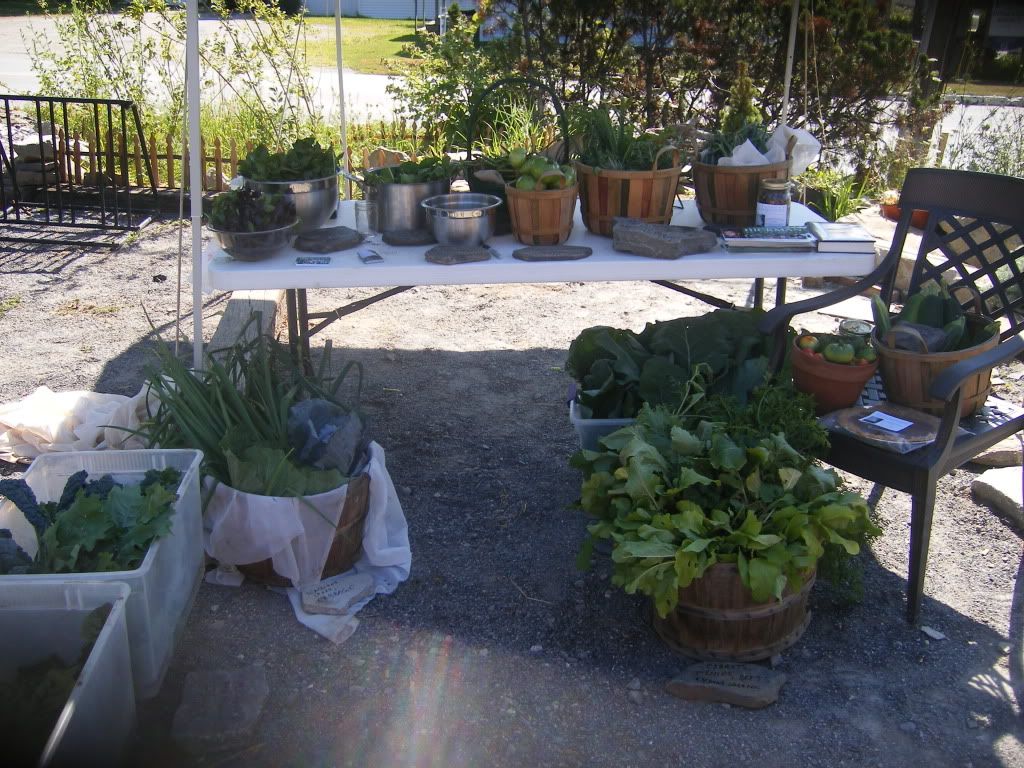
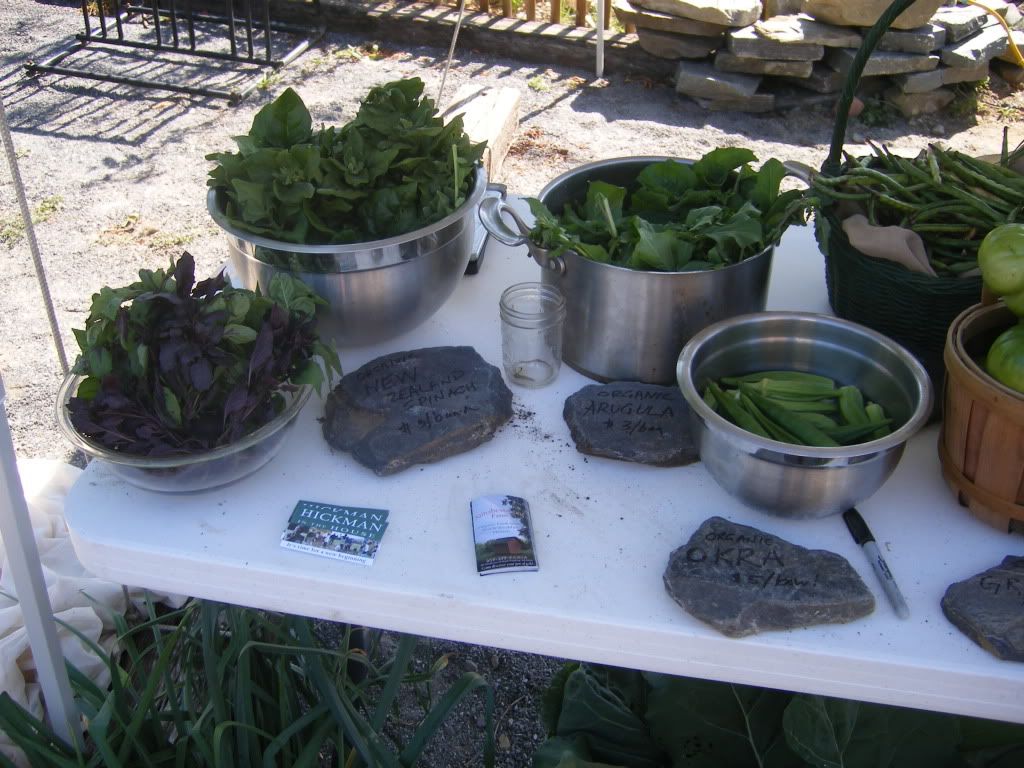
Five months later, I opened a farm stand on the side of the road right in front of our house and began selling the succulent vegetables our land offered up.
Now, I'm addicted to growing things. I've turned a mere half-acre of our farm into a sweep of organic gardens. Composted manure from around the barnyard, a small tiller for cultivation, a few farm hands, a garden rake, hoe and pitchfork, a mosquito net as necessary (which is always, much as those critters love me), and as many daylight hours as the sun above can muster is all we count on to produce our harvest.
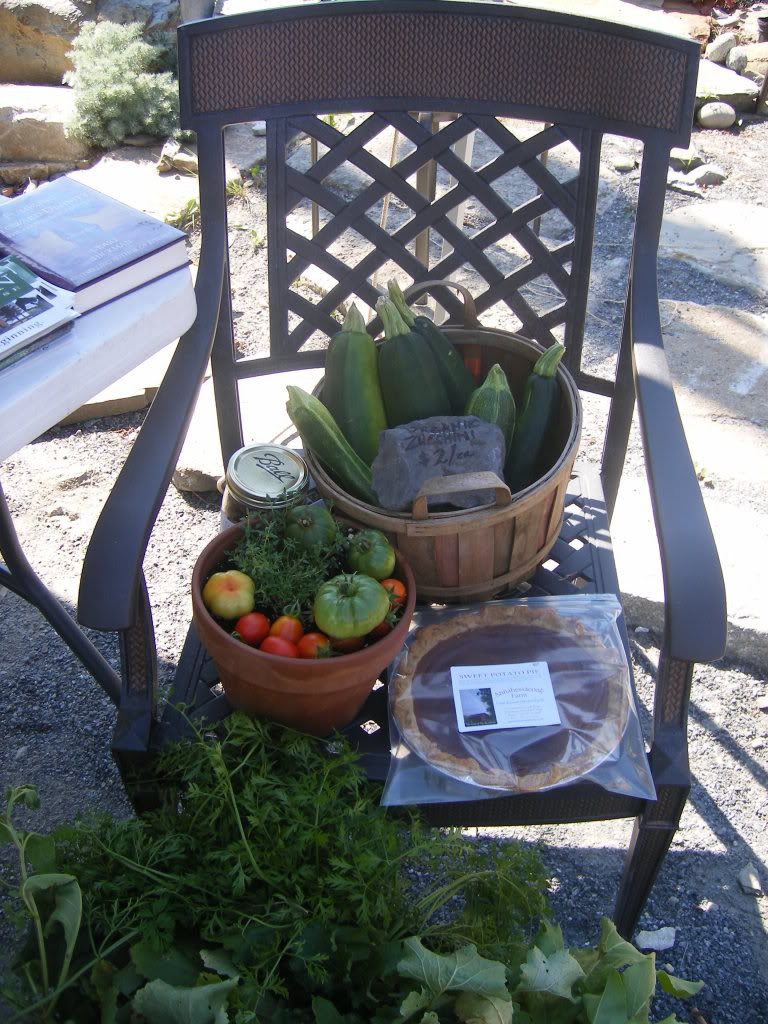
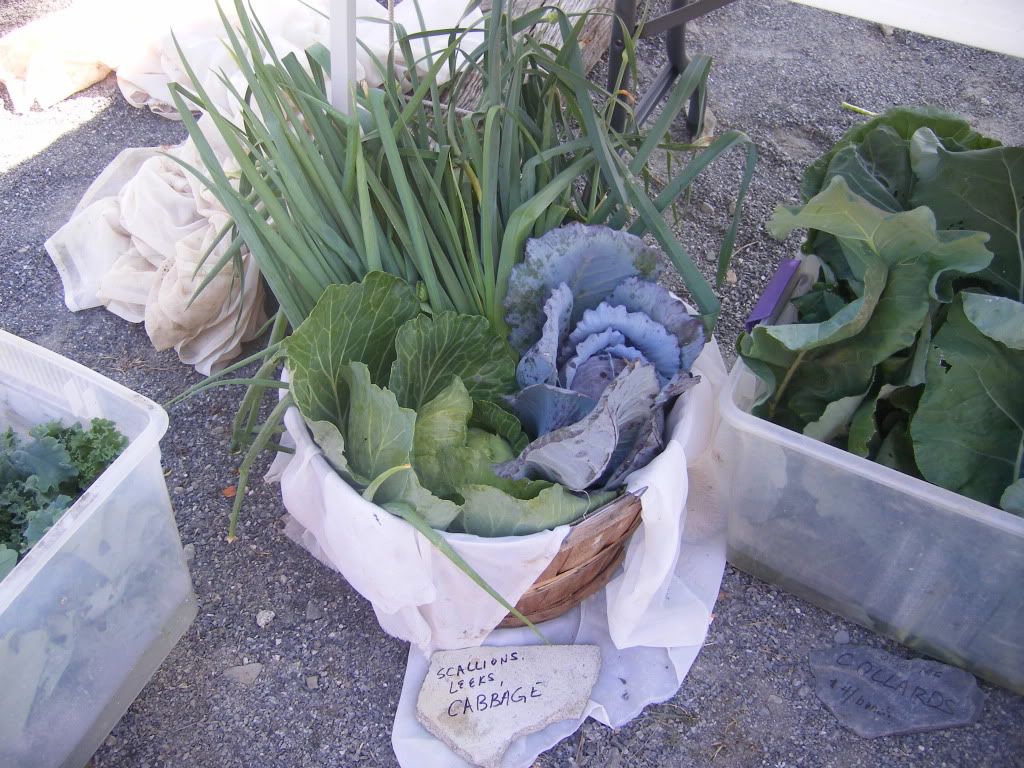
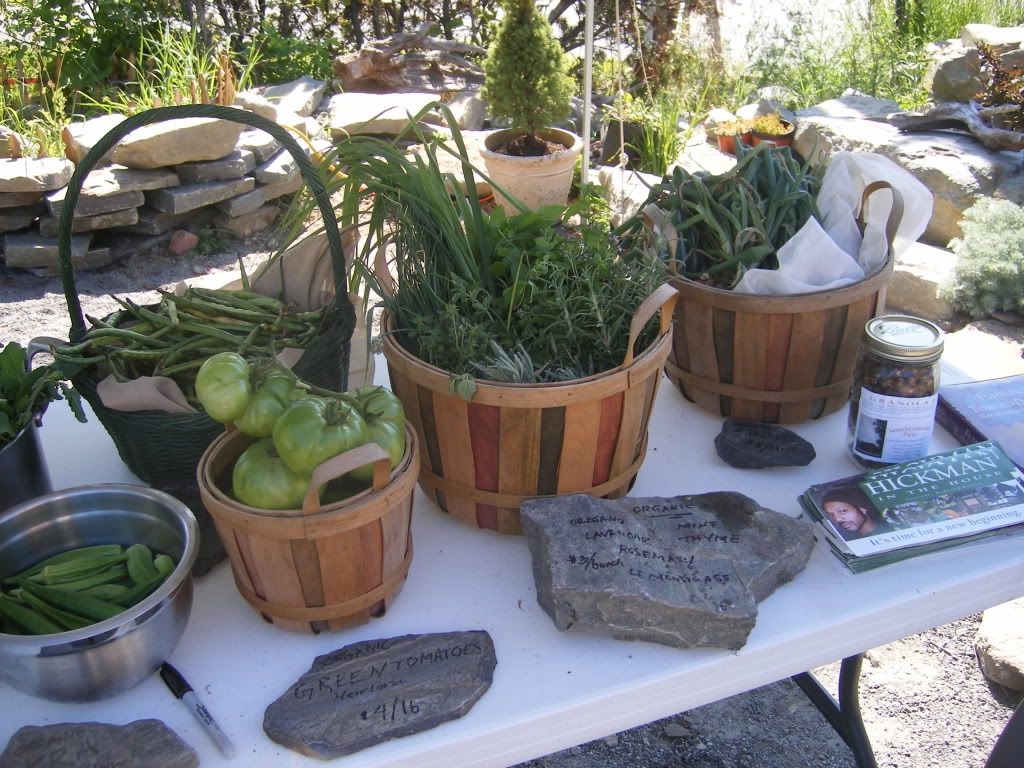
Now, I can't stop opening a new patch of earth to plant some new variety of heirloom tomatoes to round out the cornucopia from Annabessacook Farm: arugula, beets, Belgian endive, collards, kale, mesclun, mustard greens, romaine, Swiss chard, spinach, turnips, corn (the sweetest in the area, say my customers), carrots, celery, fennel, golden beets, radish, basil, chives, cilantro, parsley, rosemary, sage, tarragon, thyme, leeks, onions, scallions, blackeye peas, okra, green beans, soybeans, sugar peas, several varieties of peppers, summer squash, winter squash, gourds, pumpkins, cucumbers, eggplant, asparagus, broccoli, cabbage, cauliflower, kohlrabi, Brussels sprouts, blackberries, blueberries, raspberries, strawberries, wild black raspberries, cantaloupe, honey dew, watermelon, and anything else I can trick to grow in this northern climate. Can't stop. As though all the energy my father didn't have at the end of his life has fueled me to work from sun up to sundown, planting, weeding, hauling, turning, picking, packaging, selling. Eating.
I'm even making fresh cheese and yogurt and ice cream from the goat milk hubby massages out of our goat every evening after his day job. Baking breads and quiches and pies and cakes and hearty cereals. Preparing meals for B&B guests, private dinner banquets for neighbors and friends.
And we’ve got two new greenhouses. Can't wait to see what they can produce in winter. Before long, we’ll be growing our own wheat, making our own honey, and slaughtering our own meat.
::
I stand on my father's shoulders. He whispers music over mine as I open the earth, loving her--tenderly, deeply, desperately--and whisks mosquitoes away from my ears so I can hear his music more clearly.
He shows me the way.
I've never been more committed to anything in my life. Never been happier. There is simply nothing like living off the land and nothing simpler. Knowing exactly where your food comes from because you produce it yourself.
My customers appreciate every bag of spinach, jar of yogurt, crown of broccoli they get from here. And I appreciate them. Their concerns and requests, their own gardening triumphs and failures. Our exchange of ideas and recipes and tricks. I never would have imagined I would become such an integral part of a local food chain. Never would have imagined I could sell thousands of dollars of organic produce and prepared foods in a single season without vending at a farmer’s market or supplying a restaurant. Never would have imagined folks would stop by simply to thank me for doing what I do even though they buy their produce at another local farm. I think now of Michael Pollan's words from his must-read book In Defense Of Food, “In a short food chain… [f]ood reclaims its story, and some of its nobility, when the person who grew it hands it to you.”
So when I told one of our regular customers the story of my father's collards, my sister's recent heartbreaking confession, we all shared a moment of spontaneous silence in his memory. And I swear to God, within a week, my collards were on their way to the biggest, sweetest, greenest collards I'd ever grown.
::
Cross posted to Annabessacook Farm
Sunday, February 14, 2010
Monday, January 18, 2010
Humility Of A Man
Pitch perfect for the weekend we honor Dr. Martin Luther King, Jr.


![[July+2007+013.jpg]](https://blogger.googleusercontent.com/img/b/R29vZ2xl/AVvXsEiuQ6XgHK7911VFkZ1EgG3C4KCn22Jf-qeUQ92k5D5ZBZ2u6Mp49PQ1nJua_6bCfRINcP6jOKqxkjmQQOdo_K3meTcR7Wr546fyVSgRpXzKZGheBmAyuBjJaQkwPaacv5WuHmCJ/s1600/July+2007+013.jpg)